About LCTP
Computational research rooted in physical understanding
The laboratory studies transport phenomena across fluid mechanics, combustion, heat and mass transfer, and emerging methods for scientific computing.
Our work
Computational Methods in Classical and Quantum Hardware
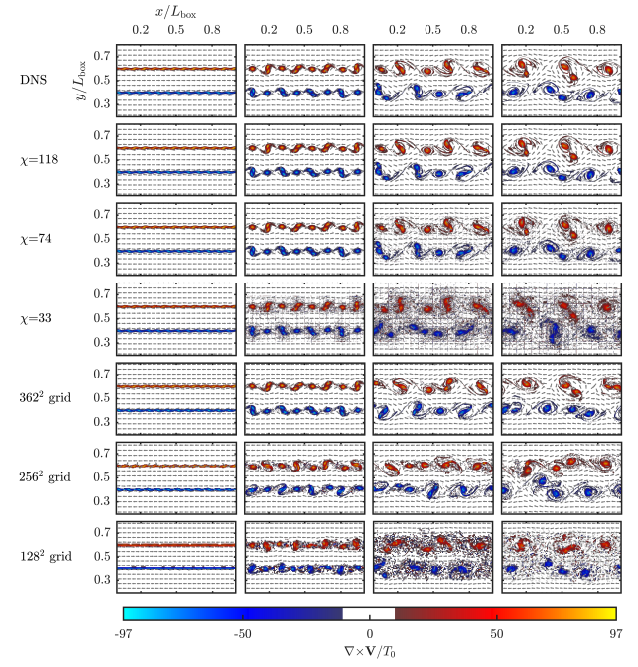
The research in this laboratory deals with fluid mechanics, combustion, heat and mass transfer, quantum-inspired and quantum-ready methods, applied mathematics, and numerical methods.
The emphasis of current research in this laboratory is on “understanding physics and practical applications.” Computational simulations are performed with the goal of studying the underlying physics in energy systems. Current general areas of investigation are turbulent mixing, chemically reacting flows, and high-speed combustion and propulsion.
The numerical methodologies in use consist of spectral methods (collocation, Galerkin), a variety of finite difference, finite volume, and finite element schemes, Lagrangian methods, and many hybrid methods, such as spectral-finite element and spectral-finite difference schemes. The laboratory is equipped with high-speed mini-supercomputers, graphics systems, and state-of-the-art hardware and software for “flow visualization.” Most computations require the use of off-site supercomputers.
People
Current Members



Former members
Alumni